

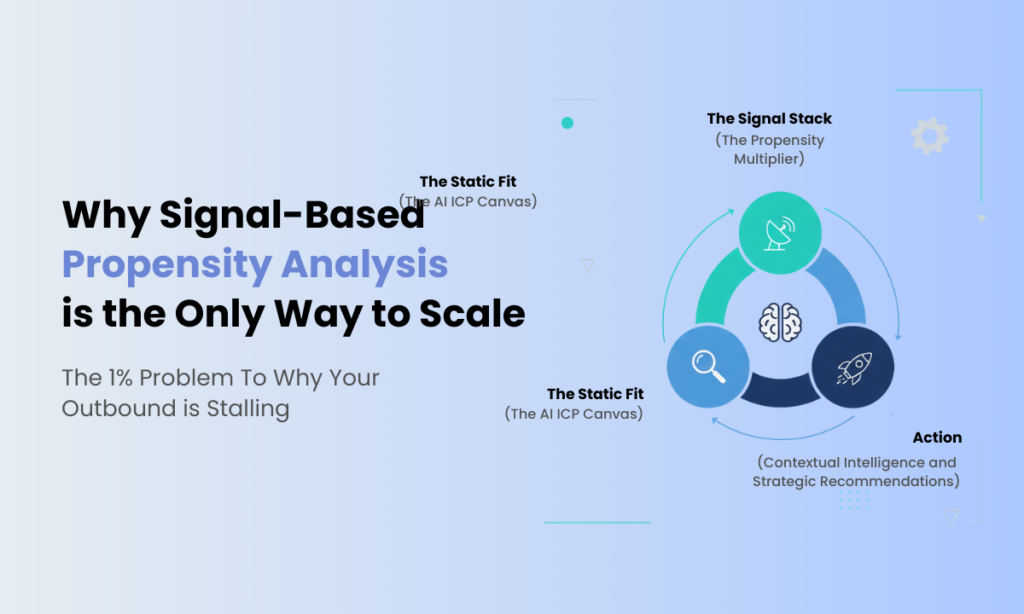
The numbers don’t lie: email outreach reply rates have crashed to 1%. For B2B sales teams still operating on static lead lists and generic messaging, 2026 is proving to be a brutal wake-up call. The solution isn’t sending more emails—it’s Propensity Analysis, a research-backed methodology that shifts focus from who leads are to why they’ll convert today.
The culprit behind declining performance? An outdated approach to lead qualification that treats all “fit” leads equally, regardless of timing, context, or actual buying intent. As AI reshapes the sales landscape, this new methodology is forcing companies to rethink everything they know about outbound.
From Snapshots to Signals: Why Static Lead Scoring Fails
Traditional lead scoring operates like a photograph—it captures a single moment in time. A company matches your ICP criteria, a prospect has the right job title, and they get added to your outreach list. But being “qualified on paper” doesn’t answer the critical question: are they ready to buy right now?
This “Snapshot Era” approach worked when buyers had more patience and inboxes were less saturated. In 2026, senior executives are drowning in cold emails, most of which miss the mark entirely because they’re targeting people who aren’t actively solving the problem you address.
The solution isn’t sending more emails. It’s identifying which prospects are showing active buying signals and have an immediate need for your solution.
Understanding Propensity Analysis: The Three-Layer Model
Propensity analysis shifts the focus from demographic fit to behavioral readiness. Instead of asking “who could buy?” it asks “who is likely to buy, and when?”
Modern AI-powered platforms are building this around a three-layer framework that mimics how top-performing SDRs naturally qualify opportunities:
Layer 1: Fundamental Fit
Before any outreach happens, prospects must clear a baseline threshold. This isn’t revolutionary—it’s basic filtering. Does their company size, industry, and tech stack align with what you sell? If not, they’re discarded to protect sender reputation and avoid wasting resources.
The advancement here is automation. AI can now process natural language descriptions of your ideal customer and cross-reference them against massive contact databases (some platforms now access 650M+ contacts) to identify only Tier-1 targets. This eliminates roughly 95% of the market that will never convert.
Layer 2: The Signal Stack
This is where propensity analysis diverges from traditional scoring. Rather than treating all qualified leads equally, AI evaluates three dimensions simultaneously:
Company signals include firmographics, but go deeper—recent funding rounds, expansion announcements, leadership changes, regulatory pressures. Is this company in a growth phase where they’d have budget and urgency?
Personal signals evaluate whether you’re reaching the actual decision-maker. A VP of Sales and a Sales Coordinator might both be “in sales,” but their authority levels are drastically different. AI can now score seniority and buying authority with precision, ensuring outreach targets people who can actually sign contracts.
Technology signals reveal the incumbent solution landscape. What tools does the company currently use? Are they likely facing integration challenges? Is their current contract expiring? For companies selling B2B software, technographics have become as important as demographics.
The breakthrough is in the weighting. Two identical job titles at similar companies can have wildly different propensity scores based on their signal stack. One might show zero buying intent. The other might be actively posting about the exact problem your product solves.
Layer 3: Contextual Intelligence
The final layer determines the “why now” and “how to engage.” AI analyzes prospects’ recent LinkedIn activity, company news, and industry participation to generate contextual hooks. Instead of generic messaging, sales teams get specific reasons to reach out based on real behavior.
Advanced systems are also automating stakeholder mapping—if your primary contact isn’t the right fit, the AI identifies alternative decision-makers within the same organization. If they are the right fit, it surfaces additional stakeholders for multi-threaded outreach strategies.
The Economic Case: Why Companies Are Adopting This Now
The shift to propensity analysis isn’t just about better targeting—it’s about survival economics.
Consider the “research tax” most sales teams pay without realizing it. To properly qualify a single high-intent lead manually, an SDR needs to check LinkedIn profiles, pull contact data from Apollo or ZoomInfo, review tech stacks on BuiltWith, scan social media for conversation hooks, and update their CRM. This takes roughly 20 minutes per prospect.
For a list of 50 leads, that’s 16.5 hours of pure research before sending a single email. At scale, this is devastating. Sales teams are paying people to be researchers, not closers.
AI propensity platforms collapse this research layer to minutes. More importantly, they consolidate what used to require 5+ separate subscriptions (contact data, technographics, social intelligence, enrichment tools) into unified systems.
The ROI becomes obvious:
- Time: 16+ hours reclaimed per week per SDR
- Cost: Eliminating redundant tool subscriptions
- Results: Higher reply rates from better-targeted, contextually relevant outreach
Why Outbound Still Works (For the Right Companies)
Despite the doom-and-gloom predictions, cold outbound isn’t dead. But the bar for success has risen dramatically.
Senior executives typically have discretionary budgets between $500K-$1M for their top three priorities—problems they need solved immediately without CFO approval. If your solution addresses one of these top-three problems, and you have a differentiated product with a clear value proposition, outbound still converts.
The catch: they don’t care about their eighth problem. They don’t care about nice-to-haves or incremental improvements. If you’re not solving a critical, immediate need, your email gets ignored.
What’s changed in 2026 is the nature of those priorities. Many enterprises now have dedicated AI transformation budgets and pressure from boards to modernize operations. Companies selling AI-enabled solutions are finding warm reception—if they can prove they solve real problems, not just add to the AI hype pile.
The AI Agent Training Reality
The proliferation of “AI SDR” tools has created a new problem: companies buying AI agents expecting them to magically fix broken sales processes.
The reality is simpler and more demanding. AI agents are multipliers, not magic. If you can’t close customers with human SDRs using proven messaging and processes, an AI agent won’t close them for you either.
Successful implementations follow a clear pattern:
First, companies document what actually works—the scripts, the hooks, the objection handlers that converted prospects into customers. Second, they train AI agents on this proven playbook, not generic templates. Third, they iterate the AI’s prompts and connect it to their proprietary data sources. Fourth, they continuously feed the AI new performance data to improve.
The LLMs available in 2025 are vastly more capable than earlier versions. But they’re tools, not autonomous salespeople. Companies that treat AI agent deployment as a strategic project with proper training and iteration are seeing 10X performance improvements. Those that buy a tool and say “figure it out” are getting 1% reply rates, just with automation.
The APAC Opportunity
While much of the AI sales tech innovation has come from Western markets, there’s a growing recognition that APAC markets require different data and approaches.
Some platforms are now building first-party databases focused specifically on APAC contacts (upwards of 60M APAC-specific contacts), addressing a gap that generic Western tools miss. For companies selling into Southeast Asia, India, or broader Asia-Pacific markets, having accurate, up-to-date data on these regions is becoming table stakes.
This regional focus matters because buying behaviors, decision-making hierarchies, and communication preferences vary significantly across APAC markets. AI trained primarily on Western sales data often misses these nuances.
What Comes Next
The companies that figure out propensity-led selling in the next 12-18 months will have a significant competitive advantage. Those that continue operating on static lists and spray-and-pray tactics will keep wondering why their metrics are declining.
The math is brutally simple: 50 high-propensity leads will always outperform 500 generic emails. The question isn’t whether to adopt signal-based approaches—it’s how quickly you can implement them before your competitors do.
For sales leaders, the transition requires a mindset shift from volume to precision, from static scoring to dynamic signals, and from manual research to AI-augmented intelligence. The technology is ready. The question is whether your organization is.
Subscribe To Get Update Latest Blog Post
[mc4wp_form id=664]




Leave Your Comment: