

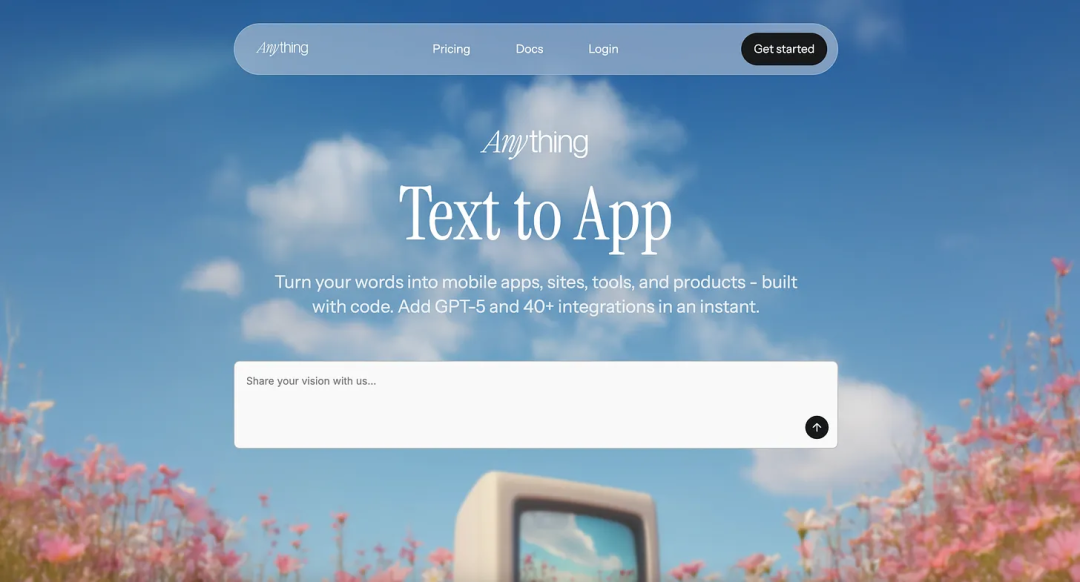
Have you ever imagined building a functional app—complete with payments, user login, and AI features—without writing code? Welcome to vibe coding, the revolutionary approach transforming ordinary people into app creators. Through vibe coding platforms, you simply describe what you want in plain English, and AI builds it for you. This vibe coding movement is already generating real income for thousands of non-technical creators.
It’s happening. A real-estate agent in Los Angeles built an AI-powered training portal. She earns $100 a month per subscriber. A barbershop owner created an AI hairstyle try-on tool linked to his client-management system. A medical student launched a CPR-training app that brings in $85 a month.
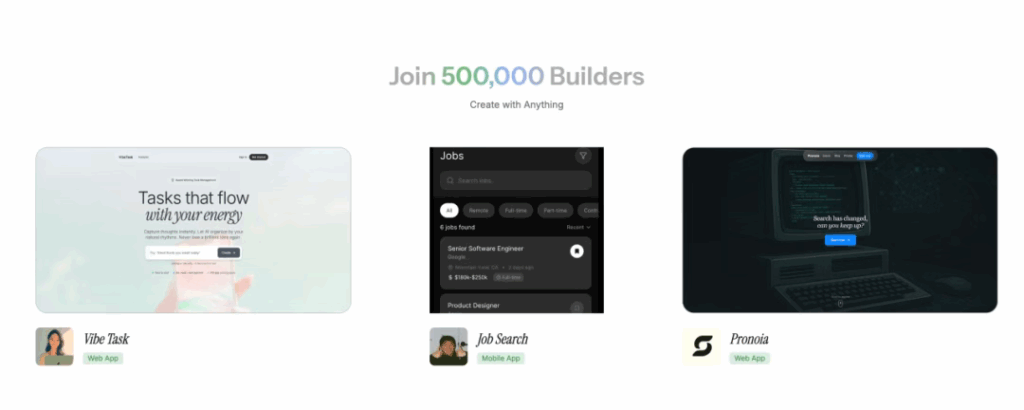
None of them are engineers. All of them are part of a revolution changing how software is created, distributed, and monetized.
The Last Mile Problem
Most AI coding tools stop short of the hard parts: authentication, payment integration, hosting, maintenance. For non-technical users, those steps are the difference between a demo and a business.
Enter Anything.
Founded by former Google engineers Dhruv Amin and Marcus Lowe, Anything tackles what they call the “last mile” problem. Their philosophy? Don’t just generate code—build complete products.
The platform bundles everything you need: database and storage, user authentication, payments and subscriptions, hosting and deployment, AI model integration. You describe your idea. The system creates the app, deploys it, and sets it live.
Amin calls it “the Shopify of software creation.” Just as Shopify made it possible for anyone to open an online store, Anything makes it possible for anyone to build and sell an app.
The traction backs that up. Within two weeks of launch, Anything hit $2 million in annualized recurring revenue and surpassed 700,000 users. More importantly? Users are already earning real income from their creations.
Meet the AI Software Engineer
Behind the platform is Anything Max, an autonomous AI agent that acts as your software engineer.
Type “Create a CRM system for small gyms with a payment portal,” and Max plans the architecture, writes frontend and backend code, generates the database, configures authentication, and deploys the app to a live server. All autonomously.
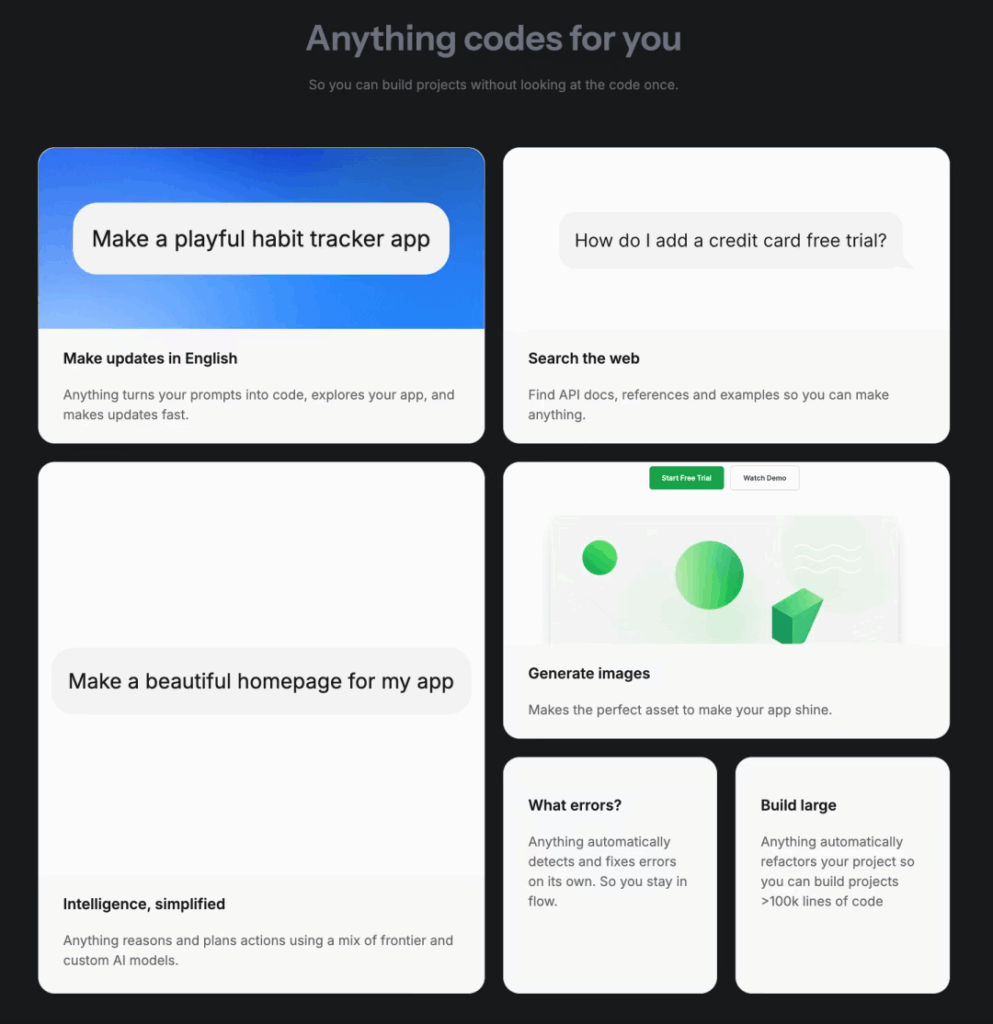
When errors occur, Max diagnoses and repairs them automatically—what Amin calls “self-healing intelligence.” This enables rapid iteration. Type “Add a social leaderboard,” and the AI updates the schema, API routes, and interface while preserving all existing data.
What used to take developers months now happens in hours.
“We don’t want to replace developers,” Amin says. “We want to empower a billion people to become creators.”
The Age of AI Agents
The technology powering these platforms represents a fundamental shift in how software gets built. Microsoft reports that 15 million developers are already using GitHub Copilot, with AI agents fundamentally transforming how code is written, deployed, and maintained.
We’re entering what Microsoft calls “the age of AI agents”—systems that can autonomously perform tasks with reasoning, memory, and decision-making capabilities.
Over 230,000 organizations, including 90% of the Fortune 500, have used Microsoft’s Copilot Studio to build AI agents. Companies like Fujitsu and NTT DATA are using these platforms to build agents that prioritize sales leads, speed proposal creation, and surface client insights. Stanford Health Care is using AI agents to alleviate administrative burdens and speed up tumor board preparation workflows.
The infrastructure behind these agents is maturing rapidly. Developers can now choose from more than 1,900 AI models, with tools like Model Leaderboards that rank top-performing models and Model Routers that select optimal models for specific tasks in real-time. This ecosystem transformation is what makes platforms like Anything possible—they’re built on robust agent frameworks that handle the complex orchestration of multiple AI systems working together.
For a deeper look at how Microsoft and other tech giants are building the infrastructure for autonomous AI agents, read Microsoft’s comprehensive overview of the open agentic web.
The Vibe Coding Landscape
Beyond Anything, the vibe coding ecosystem has exploded with specialized platforms—each solving different problems for creators at various skill levels. Lovable excels at ease of use, offering smooth end-to-end app generation with explanations at each step. Bolt provides flexibility with integrations for Stripe, Figma, and GitHub. Cursor helps debug AI-generated code with detailed improvement suggestions.
What makes these tools revolutionary is their natural language interface—English becomes the programming language, requiring minimal coding skills while still producing functional applications. You can sign up for multiple platforms, send the same prompt to each, and see which delivers the best results for your specific needs.
The key is that these aren’t just prototyping tools anymore. They’re production-ready platforms handling security, authentication, and deployment—the unglamorous but essential infrastructure that separates demos from real businesses.
The Creator Economy, but for Software
Anything’s business model mirrors the creator economy more than traditional SaaS. Users start for free, then pay a monthly subscription once their apps go live—covering hosting, compute, and AI usage credits.
The long-term vision? A marketplace for AI-built apps. Create an accounting tool for freelancers, list it publicly on the platform, and let others clone, customize, and redeploy it. Each copy generates recurring income for the original creator.
Think Shopify Themes or the App Store, but for complete, functional applications.
This structure turns software creation into an ecosystem of micro-entrepreneurs—people using AI not just to build tools but to build livelihoods. And because every app displays “Built with Anything,” the platform benefits from viral, product-led growth. Every creator becomes an organic marketer.
The timing couldn’t be better. The global creator economy was valued at $205 billion in 2024 and is projected to reach $1.3 trillion by 2033, growing at 23.3% annually. This explosive growth is driven by direct-to-fan monetization, personalized content demand, and—critically—the increasing integration of AI-powered tools that automate content production, audience engagement, and data analytics, allowing creators to scale output and refine strategies more efficiently.
Brand partnerships are shifting focus toward authentic, niche micro-creators who generate higher engagement within targeted communities. The same dynamic applies to software: instead of massive apps trying to serve everyone, we’re seeing a proliferation of micro-SaaS businesses serving specific niches with laser focus.
A New Era of Digital Literacy
Consider the evolution:
2000s: Computer literacy meant knowing Microsoft Word and Excel.
2010s: No-code literacy meant using tools like Airtable or Webflow.
2030s: AI literacy will mean being able to speak software into existence.
Instead of learning syntax or logic, users express intent—and AI handles execution.
The implications are massive. Organizations across industries are already seeing tangible impact—banking institutions automated KYC forms and cut processing times by 60%, healthcare clinics built telehealth portals improving access in underserved areas, and retail companies created custom dashboards aggregating real-time sales data, all built by non-technical staff.
Citizen developers—non-technical employees who create applications—are growing at a rate five times faster than traditional IT departments can support, with demand for their apps far outpacing what professional developers can deliver. Teachers, consultants, NGOs, and small businesses can now automate or digitize their workflows without hiring developers. The result? A wave of micro-software businesses serving niche needs big tech would never notice.
As infrastructure costs drop and generative AI improves, we could soon see tens of millions of new software creators—each building tools uniquely suited to their own industries and communities.
This is the true democratization of software: not replacing developers, but removing dependency on them. For more on how the broader low-code movement is reshaping the industry, this comprehensive analysis of low-code platforms explores the market dynamics and adoption trends in depth.
The Overnight Success That Took Years
Anything’s rise looks sudden. It wasn’t.
Amin and Lowe began working together in 2021, building tools that automated boilerplate code generation. Their early product generated over $1 million in revenue—but they shut it down when they saw GPT-3 on the horizon.
They realized text-based AI would soon replace much of their manual process. Rather than resist, they pivoted entirely to AI developer agents.
Three lessons from their journey:
Adaptation beats attachment. When technology changes, pivot boldly.
Resilience matters. Four years of iteration preceded two weeks of success.
Trend recognition is a skill. Spotting where the world is heading is often more valuable than building faster.
As Amin writes: “Keep moving forward. Keep building toward your mission. Good things will happen.”
What This Means Going Forward
AI app builders don’t spell the end of traditional software development—they change its role. Developers will focus more on high-level system design, integrations, and AI reliability. Business users will take on more creative control, turning business knowledge into working products.
This new division of labor could unlock massive productivity gains. Rather than waiting months for IT backlogs, small teams will prototype, test, and deploy their own tools instantly.
However, success requires addressing real challenges—governance to prevent shadow IT, security frameworks to protect data, and integration strategies to connect with legacy systems. Organizations need Center of Excellence models, training programs for citizen developers, and clear metrics to track time-to-market, cost savings, and compliance.
We’re entering an era where building software will be as common as building slides in PowerPoint. The real opportunity isn’t in building apps for users—it’s in building platforms that let users build their own.
For those wanting to dive deeper into the tools making this possible, Zapier’s comprehensive guide to vibe coding platforms provides hands-on testing insights across eight leading platforms, including practical tips for choosing the right tool and making the most of it.
The convergence of these trends—AI agents, vibe coding tools, and the creator economy—is creating unprecedented opportunities. To understand the full scope of how creators are monetizing in 2025, explore this detailed analysis of the creator economy market, which projects the market will exceed $1.3 trillion by 2033.
This shift will redefine what it means to be a creator, founder, or developer. Soon, millions of people worldwide—teachers, freelancers, artists, entrepreneurs—will build tools that express their unique ideas, powered entirely by AI.
The next great wave of software innovation won’t come from a handful of Silicon Valley companies.
It will come from ordinary people who finally have the power to create.
Subscribe To Get Update Latest Blog Post
[mc4wp_form id=664]

Leave Your Comment: